Christian “kitsch” a sign of the times?

When Jesus entered Jerusalem and went to the temple, he found his holy place filled with moneychangers and money-lenders. Its open walkways were lined with people trying to make a profit off of Jews, exploiting the fervently devout ones who had made a pilgrimage to the temple during holy days. (Matthew 21:12-13) The rabbis and other holy men seemed to turn a blind eye to the whole enterprise.

Jesus, zealous for his Father’s house, tore down the commercialism, overturning the sellers’ tables. Crass commercialism, profit-making off the backs of the devout—and zeal for his Father’s house aroused Christ’s wrath on its behalf. I wonder what he would say about the crass commercialization of Christianity today.

Recently we visited a Christian bookstore in search of some Francis Schaeffer books. This was not the Christian bookstore I remember from 20 years ago.

This was a large store. Before even making it through the front door, we passed tables of kitsch: toys and pens, teacups and plaques, all decorated with Christian sayings and feel-good slogans. There was even a basket of bath scrubbies–Christian bath scrubbies! Getting clean for Jesus!

Walking in, we saw that fully HALF the store was the same kind of kitsch. Cutesy pictures, wallets, glassware, candles, all with some theme meant to make us think of God. Some have trite sayings empty of content. Some are serious paintings meant to inspire but belonging to some stuffy leather-bound study of a different era.

An eighth of the store is Christian music and DVDs. Another eighth is Sunday school materials for children. That leaves a quarter of the large store for books. No wonder this line of Christian store removed the name “Bookstore” from its familiar logo. There weren’t enough books to pass for a serious bookstore.

We found Bibles and Bible commentaries, plus Christian fiction/Christian romance, and Christian living. In the Christian living portion we found Joel Osteen, Rob Bell, Brian McLaren, Rick Warren–but not Francis Schaeffer, Spurgeon, Augustine, Grudem, Walther, Sproul, Packer, or Machen. (Around the corner at Barnes and Noble we found more theology than in this store. Seriously.)

I will discuss the lack of theology in another blog post. Today, however, I want to talk about my imperfect analogy of Jesus in the temple versus the Christian bookstore. (I do realize the bookstore is not a holy place; it is a place of business. My analogy falls apart there.)

The Christian “subculture” makes up a huge number of individuals, who purchase music, books, and (some of them) kitsch. I get it. But when is it too much? And why do we purchase and sell such cheap, crass, cutesy-cuddly representations of our faith? (Remember the scrubbies? Some of them were duckies. Christian ducky scrubbies. Yes, they bothered me.) But why are we selling them? The businessman will tell me it’s because they sell. My faith tells me it is a thin veneer.

Is my display of Christian decor meant to please man or God?  And then the question is begged, does that cutesy stuff please God or man? Now, I don’t think God is offended if I have a sequined coin purse that says “I Heart Jesus.” However, is my money best spend on such nonsense? And who am I trying to please? Is this an outward display of piety meant to impress man or God?

Zechariah 7:4-10 asks and answers the question of what God thinks of the outward display of piety, the kitsch and glitz:

Then the word of the LORD of hosts came to me, saying,  “Say to all the people of the land and to the priests, `When you fasted and mourned in the fifth and seventh months these seventy years, was it actually for Me that you fasted? `When you eat and drink, do you not eat for yourselves and do you not drink for yourselves?’ “… Then the word of the LORD came to Zechariah saying, “Thus has the LORD of hosts said, `Dispense true justice and practice kindness and compassion each to his brother; and do not oppress the widow or the orphan, the stranger or the poor; and do not devise evil in your hearts against one another.'” (ESV)

In other words, man devises all sorts of ways to show his piety, but God wants something altogether different.

All the sequins and scrubbies, candles and cups can’t possibly do much more than fill the pockets of those who sell them. They don’t save me, and they certainly don’t win me more Jesus-points.

Do we buy and display all those glitzy Christian-lite trinkets in order to show off our faith? Is this an outward display used to impress others–hollow, without the internal conviction—like whitewashed tombs? Or is it an effort to make ourselves more holy?

That last thought is the most devastating–and I believe it is the closest to the truth. The beautiful truth of Christianity, which is not taught much these days, is that I cannot keep myself holy. I cannot save myself, nor can I be holy; only God can save me.

The simple truth of biblical Christianity is that God is sovereign; he is holy, and only he can save me and keep me. There is nothing I can do.

And the simple truth about all the Christian kitsch is that if this is the trend these days—to decorate one’s home so that I look better or feel better about myself, I am awfully empty inside and desperately in need of a real savior who requires nothing more of me than just me.

1 Comment

Filed under Biblical Worldview

Butchering grammar 5: Do you trust bad grammar or spelling?

That fake FaceBook post that caught so much attention recently only captured me for a second. Remember? It was the one telling us that the date for Marty McFly to zoom into the future in Back to the Future 2 had arrived. Turns out the date was wrong; that won’t happen for another three years in 2015.

What caught my attention wasn’t the bad date but the bad spelling. The word “arrives” was spelled wrong; it had only one “r.” Note to self: if I am going to try to pull off a hoax or spread an internet rumor, I should check my spelling and grammar first so I look more legitimate. Then again, if you are “brilliant” enough to want to waste your time on such a stunt, good spelling and grammar will not occur to you.

Sorry–did that sound judgmental?

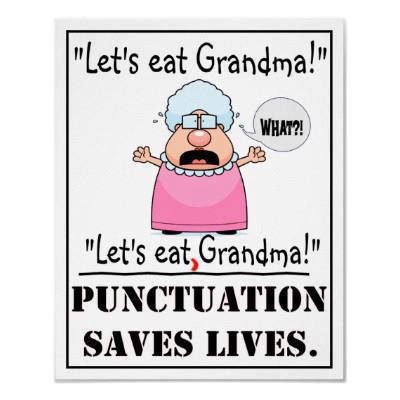
Did you know that graGrammar saves livesmmar saves lives? This gem circulated FaceBook recently, and it makes me laugh every time I look at it. What a difference a comma makes!

If you want more of that, take a look at the book Eats, Shoots and Leaves. (Did you notice that I didn’t put a comma before the book title? More on that later.) The author tackles ridiculous grammar with humor. The title is even part of a bad grammar story.

This reminds me of a couple more comma errors made all too often. I see these in my students at times, but I also see them in blogs and news articles.

When you use a conjunction (and, but, or, so, etc.), you don’t always need to use a comma. Only use a comma when what follows the conjunction is an independent clause. In other words, what follows the conjunction could stand alone as its own sentence. For example, “I had the pork chops, but she enjoyed the spaghetti.” The comma goes BEFORE the conjunction, not after. What followed the conjunction was a complete sentence (or independent clause).

Try this one: “I loved the pork chops but hated the green beans.” What follows the conjunction (“hated the green beans”) is not an independent clause; it could not stand by itself as a sentence. There is no comma after the conjunction.

One more comma problem. See the book title above: Eats, Shoots and Leaves? I’m not going to give away the story that goes with that title; you should find the book and read about it. However, someone put a comma after “eats” in order to introduce what comes after. That’s wrong punctuation. Let me give you another example. “Samuel went to the store to buy, milk, eggs, and cheese.” Why is this poor comma having to be somewhere he shouldn’t? A comma does not introduce a list. A colon does, but not here. Why? The list is integrated into the sentence. Use the colon when it can introduce the list. “Here’s what Samuel got at the store: milk, eggs, and cheese.”

A few paragraphs above here I did not put a comma before the book title. That’s because the comma does not introduce the book title. There is no reason for it.

Almost all of my examples involve food today. Sorry about that. Happy writing; happy eating!

Leave a comment

Filed under Grammar

Butchering grammar 4: conquering the verbing slackers

You know what else bugs me? Improper use of the singular/plural agreement, and repetitively redundant repetitions.

First, let’s look at the poor slobs who cannot count. (Don’t worry; I did not call you a slob. I wasn’t looking at you.)  If you use a singular noun or pronoun, you should pair it with a singular verb. Plural noun gets a plural verb. Take the following sentence. Please. “There isn’t many calories in there.” Really, this is pretty clear, don’t you think? The word “calories” is plural, so the verb should be plural as well. “There aren’t many calories in there.”

Here’s another singular/plural problem. “There’s less pesticides in there.” This actually has a couple of serious flaws. Did you find them? First, the plural: “There are … pesticides.” Great. Fixed. Now, look at the word “less.” That word refers to size, not numbers. The word “fewer” refers to number. So we would say “There are FEWER pesticides.”

Digression (are you surprised that I digress? It’s my middle name): A Mercedes car commercial says “Less doors.” Fingernails on a chalkboard to me. Really? Your doors are smaller? Lesser? That should have said “Fewer doors.” Some guy got paid a few million dollars for that genius statement.

Now for the third error: unnecessarily repetitive. “There are fewer pesticides in there” may be grammatically correct, but it is too repetitive. Find another way to say “in there,” or just get rid of it altogether. You do not need two “there” in one sentence.

Here’s another example of redundant repetitiveness, unnecessarily duplicating thought over and over. “The reason why is because…” Don’t tell me why three times! My students use this one a lot when defending their ideas in class. Each term, “reason, why, because,” tells me why. Choose one of those words and restructure your reasoning. Say “The reason is…” or “I’ll tell you why” or “That is because…” Vary your wording to make it more readable, more enjoyable for your reader. And often your reader is judging you. Especially if your reader is me.

1 Comment

Filed under Grammar

Butchering grammar 3 for me

Several of my readers suggested some poor grammar that needs to be put out of its misery. Thanks for the contributions–send me more! I’d even accept photos of bad signage. Those are the most offensive, because in my (oh-so-humble) opinion these signs perpetuate more bad grammar. Their owners should be flogged.

Some readers talked about the offensive use of “I” versus “me.” (And, by the way, did you notice that the period just went inside the quotation marks? Unless you are British or Australian, you should do it my way–the right way. Refer to the MLA Handbook for Research Writers for the proper use of punctuation, an essential resource for your desk. Anyway, I digress, again.)

I’m not going to bore you with the terminology, the names and rules. Let’s just look at what works well. “Me and Angie are going to the store” is wrong on two counts. First, never put yourself first when talking about yourself. Why, you ask? This is not all about you. Put yourself last; it is more polite. Don’t hog the attention.

Secondly, you would not say, “Me is going to the store.” Well, I hope you wouldn’t say that. You would instead say, “I am going to the store.” Right? So then fix the whole thing: “Angie and I are going to the store.” Put yourself last and say “I am” to remind yourself of whether it is “I” or “me.”

Let’s look at another example of this. One reader used the following example: “My mother gave cookies to Sally and I.” Okay, you say, you just lectured me on the right use of I, and now you’re telling me this is wrong. I don’t get it.

Here’s what you need to get: Simplify this sentence and take Sally out of it. “My mother gave cookies to I.” Does that sound right? of course not! You would properly say, “My mother gave cookies to me.” So why don’t you say it correctly? “My mother gave cookies to Sally and me.” She gave them to me, right? Not I. (And did you notice? We put ourselves last and Sally first. Good for us; we’re polite.)

1 Comment

Filed under Grammar

Butchering grammar 2: a lot of apostrophe abuse

While I wanted to spend some time telling you how “alot” is not a word and was never meant to be a word, I have encountered a lot (!) of a certain kind of error that particularly bugs me–a lot–and I will have to forego telling you why “alot” is a horror and its use should be punishable by flogging.

I also wanted to talk about the abused pronoun. You know, when someone means well but says something shocking like, “That child finds themself in a lot of trouble…” It hurt just now to write that well-intended but shockingly illiterate-sounding sentence. But I digress. We’ll address that one later. A lot.

What I am bugged about is that poor, abused apostrophe. Goodness, have you noticed how the apostrophe has been misplaced, misused, forgotten, or over-used lately? I give you a few examples to ponder.

  • A sign near my house advertised puppy’s for sale. Hold on. Maybe the owner genuinely meant to say “My puppy’s for sale,” meaning his ONE puppy has got to go. But somehow I doubt it.
  • Just like the hand-painted sign above, I am even more disappointed with professionally-made signs that refer to items in the plural but use an apostrophe to make them plural: “All sandal’s on sale” or “Open Sunday’s.” When did adding apostrophe-s make something plural? I deal with this in my own students’ writing every year, and it makes me slightly crazy. That poor apostrophe–I feel a bit protective of him. He does not need to be used in this way! Give him a break!
  • The next one happens quite frequently in a group of friends or small group Bible studies. The email gets passed around: “Our study is at the Smith’s house.” In other words, the house of the Smiths. Pay attention to this one: if it is the house of the Smiths (plural, right?), then it should be at the Smiths’ house. See the difference?
  • One more misuse, and this should probably be an entire blog subject itself. The word “its” can either be used correctly or can suffer from misplaced apostrophe. When is that word to be used? “Its” means “belonging to it,” as in “the dog had its puppy’s.” (Just kidding–you know that rule already. Puppies.) “It’s” means “it is.” That little apostrophe takes the place of the “i” in “is.” The only thing to remember is the difference between “belonging to it” and “it is.” You can do that, right?

A lot.

2 Comments

Filed under Grammar

Butchering grammar, one fragment at a time

Wouldn’t it be great if we didn’t need Grammar Police? If everyone just played nicely and spoke well, wouldn’t the world be just a little bit better?

I plan to point out to you some areas where grammar is poor and English usage could improve. This is an invitation to all of you. Contribute to my list! As if I could possibly run out!

The following wins today’s prize. Stand in line at a store—or just about anywhere you need to be waited on. An employee is freed up, and he or she calls out, “I can help who’s ever next!”

Hold on. You can do what? To whom? Who is ever going to be next? Or am I ever, always, next? I never feel ever next, anywhere I go. I wonder what that means for me. More to the point, will you help me if I am ever next?

The speaker, I believe, if I can interpret her meaning, is trying to say, “I can help whoever is next.” But halfway through the invitation, she butchers the language, mixing up the pronoun and misplacing the verb for a brief moment. I would like to spend time correcting her grammar, but I have waited in line for too long, and I am ever next.

Leave a comment

Filed under Grammar

A Good Book is Not Hard to Find

Bookshelf


Well, it isn’t hard to find if you apply the criteria I have described in the last two blogs, here and here. If you do not want to discriminate about what you read, and you subscribe to the idea that mindless “beach-reading” books are the way to go, then you won’t want to read any further.

My top picks

This is hard to do, like trying to choose my favorite child. While each of my children likes to say he or she is my favorite, and I agree with each one in turn, I really don’t have a favorite. But I digress.

Below I have listed what I consider to be my top classic picks, but somehow I am certain I have missed a few. While my librarian son protests that certain classics are missing from this list, either I haven’t read them yet, or I do not like them very much.

And then I have listed other favorites, lighter reads, not necessarily classics but excellent books in their own right. These two lists consist of what I consider must-haves on the bookshelf. Please send me your favorite titles and tell me why you like them. Don’t send me mindless fluff!

These are in no particular order. Dim the lights; here we go.

  • Atlas Shrugged by Ayn Rand
  • Pride and Prejudice by Jane Austen (and I love many of her other books as well)
  • Frankenstein by Mary Shelley
  • Beowulf, an anonymous work—phenomenal depiction of the hero epic
  • To Kill a Mockingbird by Harper Lee
  • Tale of Two Cities by Charles Dickens (the only Dickens I can recommend)
  • Last of the Mohicans by James Fenimore Cooper (not the movie—it’s all wrong)
  • The Count of Monte Cristo by Alexandre Dumas
  • The Adventures of Tom Sawyer by Mark Twain
  • Rebecca by Daphne DuMaurier
  • Paradise Lost by John Milton
  • Killer Angels by Michael Shaara (his son, Jeff, has written many more of this same genre, all extremely good)
  • Taming of the Shrew, Macbeth, King Lear, Hamlet by William Shakespeare (to name just a few)
  • The Hobbit, The Lord of the Rings trilogy by JRR Tolkien
  • Picture of Dorian Gray by Oscar Wilde

Other excellent reads, very enjoyable, almost like dessert.

  • The entire Harry Potter series by JK Rowling
  • The Flavia de Luce series by Alan Bradley
  • Coming Home and September by Rosamund Pilcher (the closest you will see me getting to any kind of modern romance)
  • Any of the Lord Peter Wimsey novels by Dorothy Sayers
  • Anne of Green Gables novels by Lucy Maud Montgomery
  • The Hunger Games trilogy by Suzanne Collins (warning: disturbing violence)
  • Ender’s Game by Orson Scott Card
  • Divergent series by Veronica Roth
  • The Help by Kathryn Stockett
  • Hammer of God by Bo Giertz
  • Imperial Woman and others by Pearl S. Buck
  • Cold Sassy Tree by Olive Ann Burns
  • Death Comes for the Archbishop by Willa Cather
  • Pillar of Iron and others by Taylor Caldwell
  • The Big Fisherman and others by Lloyd C. Douglas
  • Animal Farm by George Orwell
  • Peace Like a River by Leif Enger
  • Name of the Wind by Patrick Rothfuss
  • Any Jeff Shaara novel
  • The Firm by John Grisham (and most of his earlier novels)
  • Hunt for Red October by Tom Clancy (and most of his earlier novels–written by Clancy alone)
  • Wizard of Oz series by L. Frank Baum
  • The Little House series by Laura Ingalls Wilder
  • The Chronicles of Narnia by CS Lewis
  • Winnie the Pooh books by AA Milne
  • North and South by Elizabeth Gaskell
  • Charlotte’s Web and The Trumpet of the Swan by EB White
  • Lord of the Flies by William Golding (Well, not dessert. In fact, don’t eat dessert while reading this.)
  • Jane Eyre by Charlotte Bronte
  • Tenant of Wildfell Hall by Anne Bronte
  • Sir Gawain and the Green Knight by Anonymous

Some links for excellent books, other readers’ top picks. (These are not my picks; consider the sources before you choose a book from here. Also read my blog about the elements of great literature.)

http://childrensbooksguide.com/top-100

http://www.harvard.com/shelves/top100/

http://m.guardian.co.uk/books/2003/oct/12/features.fiction?cat=books&type=article

http://www.nytimes.com/library/books/072098best-novels-list.html (There’s no accounting for good punctuation here; why the NYT does not italicize book titles is beyond me.)

What are your favorite classics? What is missing from my list? Remember my criteria, and remember I reserve the right to shoot down any fluffy books that have the audacity to aim for my classic bookshelf.

3 Comments

Filed under Biblical Worldview, Literature

Bibles, Bonnets, and Brides: Christian Romance

When we moved from the Southwest US to the Midwest, I experienced some culture shock in the form of food. Craving Mexican food, we tried restaurant after restaurant. Nothing met our expectations; most of it seemed like ketchup with a little chili powder mixed in. Honestly, what self-respecting Mexican place offers a menu item called a “wet burrito”? Yet there it was in Michigan, all over the place. The idea that Taco Bell was true Mexican food…well, that just burned me like Mom’s huevos rancheros.

And the shock continued when entering the grocery store. Chili powder did have some ground-up chilies for color, but also a list of other spices tossed in, only diluting the lovely, smoky taste of pure chili powder. A search for corn tortillas showed me the disappointing nature of grocers in the Midwest: those crispy taco shells are the only things closely resembling corn tortillas, but there are no soft corn tortillas in many Midwestern grocery stores.

What does this have to do with fiction?

This has everything to do with the taste that one develops. Having grown up in the Southwest, eating typical New Mexican dishes, I developed a discriminating taste. Something less than that wonderful, pure red-chili flavor was disappointing, and not really what I wanted to settle for.

One can “develop taste” similarly with many other things: housing, fashion, music, or literature. If you have lived on a diet of junk food all along, you won’t know or appreciate gourmet food. When you partake of a steady diet of excellent literature, you are able to identify the characteristics of quality. And you will dislike literature of a lesser quality.

Which brings us to Christian fiction.

Most Christian fiction falls into two categories: Christian romance and Christian mystery/spiritual battles. Much of Christian romance is poorly written and follows a fairly predictable formula. They are not much better than Harlequin Romance books: they follow an impracticable romantic recipe that rarely changes.

When I was in junior high, a friend’s mom read many Harlequin Romances every week. Intrigued, I borrowed a few from her. It didn’t take very many books for me to find out that they were trash: very low quality writing, predictable formula, boring. I didn’t recognize it then, but the titillation of a Harlequin Romance causes the reader to fantasize, wish for a different or more exciting life, and eventually to become dissatisfied with her own life. In some cases, the titillation—the description of the love affair itself—is akin to soft porn. It becomes addicting.

I concluded, early in my young life, that the Harlequin novel was of poor substance, because I had been fed a steady diet of quality literature from my mother’s lap. She supplied us with much classical literature, curled up with us to read poetry, and took us to the theater (and opera) as much as she could. Thus from a young age I could distinguish between “trashy” novels and classical literature—just as I can between Taco Bell and true New Mexican food, or between McDonald’s and a good filet mignon.

Like the Harlequin Romance, Christian romance novels lure their readers into a dreamy, unrealistic view of love—albeit a cleaner one. The typical pattern of a romance novel only varies slightly: boy meets girl (or vice versa), boy loses girl, boy goes through a life-quest to find meaning. Boy regains girl. Add the Christian label, and you find some sort of loss-of-faith/faith-quest/coming-to-faith pattern mixed in.

Often, too, the characters are not at all realistically portrayed. Their dialogue is stilted and stiff, not at all the way you and I would normally speak (nor, I suspect, the way pioneers spoke to one another…). Men are strapping and strong, handsome and virile, perfect–without flaw (except the one bad guy…who’s really bad…and poorly portrayed). The women are flawed, weak, indecisive, abused, or neglected in the past.

They need rescuing. Yes, in fact, we all do (that is a great spiritual truth)! However, the unrealistic juxtaposition of these two character types is puzzling. Since the readers are women, are the main female characters portrayed this way so that the reader can project herself into that character? Does that enable the reader to fantasize herself in that role? This is just my guess.

However, contrast that aspect with great classical literature. Romance for romance (and I will argue that these are not “simple” romances, but let’s just say, for argument’s sake), Jane Austen’s novels portray weakness and flaws in every character, realistically. Women need rescuing at times, but at others, they are the ones whose brains are the only ones working for a time. Men are strong yet flawed, egotistical yet self-conscious. Austen’s stories are rich, beautifully written, timeless. I have yet to find those qualities in a Christian Romance.

Rarely do those novels ever resemble reality. If the effect of a Harlequin Romance is to draw the reader into soft porn, the Christian romance is a low-key version of the same. The result: increased dissatisfaction with one’s current life while daydreaming and fantasizing about the perfect romantic partner in some exotic, or pastoral, setting. (Just add a pastor.)

Just a sampling of bonneted beauties on the cover of some Christian Romance novels…

For some reason, many Christian romance novels feature pioneers or Amish women. Visiting a local library, we engaged in a totally unscientific survey: we pulled a cross-section of Christian novels off the shelf. We looked through 23 books and were astounded to find a whopping 8 bonneted beauties on the cover. Why? Perhaps because that time or place was supposed to be more simple, more romantic? I am still puzzling over that one. (If you have an idea, please chime in.)

If you have read my other blog about quality literature and read some of the suggested materials on discerning good reading material, you know that “good literature” can be Christian or secular. So can bad.

The quality of excellent literature constitutes how well the story is told—how well the picture is painted in the mind of the reader. Is the moral dilemma—the tension between good and evil—presented well? Does the book reward re-reading? Do the characters come to life? Is the vocabulary, and the writer’s voice, rich? Will the story stand the test of time, and will it make sense, will it ring true, four decades or a century from now? If you can answer yes to these questions, you may have a piece of quality literature in front of you.

Why do many Christian authors stop short of excellent literature? Your guess is as good as mine. Why do secular authors? Probably we’ll find the answer is the same for both. Danielle Steele writes countless secular romance novels, and she has done so for twenty or thirty years. They sell well. But like Harlequin Romances, Steele’s novels are not well-written. They are formulaic, predictable, simplistic, and they oftentimes don’t even bother with good grammar. (Yes, I read some. I picked them up to see what all the buzz was about. Frankly, I was more bothered that so many readers spend money on such poor writing, than that she writes them. She makes plenty of money, so her strategy works!)

Instead of settling for (or limiting themselves to) the majority of fiction labeled as Christian literature, parents should teach their children how to discern what is good about all literature. They should teach their children how to tell the difference, develop their palate for what is excellent.

Certainly some literature is to be avoided due to its content, its language, or its unnecessarily graphic depictions. Be willing to explain the criteria to your child and why certain books do not meet those criteria.

Here’s the challenge for Christian parents: explore your standards from a biblical worldview: watch the depiction of good and evil. Is it a battle? Does the moral tension reflect reality? Is good truly good, and is sin truly distasteful? Whether Christian or secular, does it gloss over the reality of evil and its consequences? Does moral tension drive the plot, or does the romantic, unrealistic quest for true love drive the story? Is immorality sugar-coated, underplayed, and simplistic, or is it real?

If up to this point you have limited yourself to Christian novels simply because you don’t have to do the work of discerning what’s good literature, step up to the challenge. Read the classics. Try some gourmet food instead of McDonald’s.

Next installment: My picks for excellent literature (you may be surprised!)

8 Comments

Filed under Biblical Worldview, Literature

Partaking of fiction with a biblical worldview (part 1)

Numerous parents over the past two decades have approached me with grave concerns over what their children are reading. Their concerns are wide-ranging and unpredictable.

Some say that their children should only read specifically Christian literature; anything else would be too much of the world. In fact, I taught for a year at a Christian school whose curriculum oversight committee refused to allow its students to read anything besides specifically Christian literature. To repeat, I taught there only a year.

Some parents allow their children to read a small selection of secular fiction, but they fret over it. (“Should they really read these books with sinful characters?”) Others take a very relaxed stance, allowing their children to read whatever their hearts desire, but not helping provide any kind of filter through which to read and understand this literature.

Same goes for movies, only more so. Since it is such a visual medium, movies are more scary to parents, who approach them with fear and caution—and rightly so.

This all begs an important question: What standards can Christians apply toward viewing/reading fiction?

The obvious answer is the Bible. Most parents will use Philippians 4:8 as the criteria for judging the readability of a book: “Finally, brethren, whatever is true, whatever is honorable, whatever is just, whatever is pure, whatever is lovely, whatever is commendable, if there is any excellence, if anything worthy of praise, think about these things” (ESV). Then they look at the work of fiction to see what is lovely, honorable, and just.

This is an excellent standard for a start. Let’s consider adding more of God’s Word to this list of criteria.

First, realize that “whatever is lovely” wants us to dwell on truth and beauty. Also realize that “whatever is true” includes not just beauty but also the whole truth about, well, truth. What’s true and real is that this world is full of sin. It’s ugly, and it warps everything it touches. And evil is evil; it is to be avoided, not desired.

How best to show that evil has consequences? Depict it in all its ugliness, and watch the consequences unfold. Well-written fiction will do just that. However, sugar-coating the truth provides an unrealistic picture of the “real world.” Does this mean that students should read every kind of pulp fiction out there? Absolutely not. Find good fiction that shows the true tension of good versus evil, that shows the repugnance of evil. Take a careful look at what happens when people give in to it.

Some of the dark literature of modernity will provide excellent examples. I want my students to read about the cry of man’s heart: “What do I do with the darkness I have inside me?” In realistically-depicted fiction, we can see what happens when man cries out for a savior and then tries to save himself, or invents his own savior, or destroys himself in pursuit of a better life. Perhaps he creates a whole new society in which everything can be manipulated so that human emotions and attitudes can be tightly controlled. We see how successful that is in Animal Farm, 1984, Brave New World, Hunger Games, Divergent, Anthem, and Atlas Shrugged, to name just a few. And can a student learn something from the failed experiment of the creation of a new society? You bet.

The naked, ugly truth is that deep down, man cries out for a savior. That heart-wrenching agony can be clearly seen in Romans 7, in which Paul tells the truth of man’s situation: the things I want to do, I don’t do; those things I don’t want to do, I do. Then Paul cries out “Wretched man that I am! Who will deliver me from this body of death?” (Romans 7:24). Isn’t this what every person despairs of, at some point in his life? What kind of sugar-coated, romanticized fiction ever depicts ugly, unbearable truth like that? Rarely does Christian fiction do it well.

However, look at Picture of Dorian Gray, Heart of Darkness, and The Strange Case of Dr. Jekyll and Mr. Hyde, for example. The futility of trying to overcome one’s weaknesses by creating some sort of hero oneself is portrayed in all of its dark brutality. Did these authors know the one, true God? Some will argue the answer; however, it is clear that these authors realized the futility in their own lives and expressed it clearly.

Can a non-Christian depict the truth in his work of fiction? For an answer, take a look at Les Miserables or A Tale of Two Cities. (Some will argue that Dickens was a Christian; we will not take up that argument here—someone else can. We do know that Hugo was an avowed pagan.) What about revenge and its devastating results in The Count of Monte Cristo? The beauty of reconciliation and repentance is laid out clearly in all these books. Did God use these men? I would argue that yes, he did—and does.

So how do we approach literature with our children? Teach them the truth of the Law and the Gospel. Man is sinful and cannot save himself. He desperately needs a savior and tries to fill the void with his own works and inventions. Dead in his own sins, God reaches in and pulls him up out of the grave and into life. How tragic for those who have not been made alive by God!

Let’s see how this is played out in literature.

For more reading on how to view literature from a biblical worldview, see Reading Between the Lines by Gene Veith, The Twelve Trademarks of Literature by Jeff Baldwin, and How to Read Slowly by James Sire.

Part Two: “Bibles, Bonnets, and Brides: Christian Fiction”

3 Comments

Filed under Biblical Worldview, Literature

Lessons from Job

My signature has changed.

That may not sound like much, but if you think about it, it’s pretty significant. I have lived with such tremendous pain for several months, that several physical changes have resulted.

Some are (I hope) temporary. Like the long-term dizziness and brain fog I’m experiencing. The fog kept me from reading too much at one time, or even finishing my thoughts completely. My family and friends have begun to finish my sentences for me in conversations.  (I actually typed a partial sentence here and couldn’t remember what I meant to say…)

The dizziness keeps me from walking too much, too quickly. Does pain make you dizzy? I guess it does, because drugs or no drugs, my head spins at unexpected times. That is ebbing away this past week, so I hope that the worst of my dizzy days are behind me.

Now for my signature. Chronic pain changes so many things. My strength is gone; stamina too. Holding a pen or pencil is an exercise in pain. When I need to sign a form at a doctor’s office or a charge at a store, I notice how jumpy my signature is. I no longer have the ability to control that pen the way I used to, and I do not recognize my own handwriting. Take notes in church? Forget it. This from the woman who is a writer, who has lived with a callous on the middle finger of her writing hand since high school. Pain has changed nearly everything. Nearly.

On those forms I need to fill out for each new doctor I visit, I must answer myriad questions about what my pain is like. Has your appetite changed? Your sleeping habits? Your temperament? Are you depressed? Talk about writer’s cramp. I could say a lot, but since I can’t hold a pen long, I must be brief.

Nearly everything has changed, as I said. I’ve lost a lot of weight, about which I do not complain. I had been only sleeping 1-2 hours at a time, until the doctor relented and gave me some drugs to help me sleep. Now I can make it until pain wakes me up at 5 or 5:30.

Depressed? Indeed. Wouldn’t you be depressed if you lived with unrelenting pain, 24/7? Depression is something I never thought I’d succumb to, but here I am. I can identify with Job, who lamented the day he was born. He sat in the ashes and scraped his sores, feeling sorry for himself. And who could blame him?

As for the temperament question, I asked friends and family if I had become irritable or if they had noticed my mood changed. No, they all agreed, but you are low in spirit. Again, who could blame me? But I am glad I haven’t given in to beating up on the people I love the most. Nor have I cursed God. Job’s wife told him to “curse God and die,” something he never gave in to.

Job lost everything. First his property, then his family, and finally his health. In all of it, Job never lost his faith. He lamented loudly, cursed the day he was born, wished that God would just end his misery (but never contemplated ending his own life), and debated with his friends over the cause of suffering. Yet he knew, in the depth of his soul, that God is good and that God is his redeemer.

As for me, I know that my Redeemer lives, And at the last He will take His stand on the earth. Even after my skin is destroyed, Yet from my flesh I shall see God; Whom I myself shall behold, And whom my eyes will see and not another. My heart faints within me! (Job 19:25-27)

I began learning from Job when I was 15. Then my dad was in an irreversible coma, and we existed in a black wasteland, awaiting word that his body had finally given up. I lamented, naturally, and a family friend told me to read Job. Not many people can tell you that Job saved them, but I believe that God put me right in the middle of Job again and again over the next few years. He strengthened my faith while I watched Job’s tormented cries. He reassured me when I read God’s answer to Job and his friends. I loved seeing Job hang tenaciously on to his faith, despite what his friends said or did, and despite what state his tormented mind and body was in.

I’m reading Job again, which should not surprise those closest to me. This time I’m digging into the footnotes and commentary in the Lutheran Study Bible. Luther said something amazing:

When faith begins, God does not forsake it; He lays the holy cross on our backs to strengthen us and to make faith powerful in us… Where suffering and the cross are found, there the Gospel can show and exercise its power. It is a Word of life. Therefore it must exercise all its power in death. In the absence of dying and death it can do nothing, and no one can become aware that it has such power and is stronger than sin and death.

Again, another footnote from the Lutheran Study Bible, regarding Job 3, provides some encouragement:

Even the most optimistic people will reach despair when overwhelmed by pain and suffering, as the examples of prisoners of war demonstrate. The mind snaps just as bones do. Scripture does not teach that death is a friend to those who suffer–death is always an enemy (1 Cor 15:26), but one overcome by the Lord. Commend those who despair to Jesus, who likewise cried, “My God, My God, why have You forsaken me?” (Matt 27:46) and rose from the dead to say, “Peace be with you” (John 20:21).

So just as in my teens I found solace in Job, and agreed with him that “my Redeemer lives,” and in my 20s when I lost a baby and despaired, now in this stage of my life when I am living through the most difficult pain I have ever experienced, I can still say with Job, “Though he slay me, I will hope in him” (Job 13:15). Why can I say that? Because I lean on a verse from my other “favorite” book of the Bible, John. “I give eternal life to them, and they will never perish; and no one will snatch them out of My hand” (John 10:28). I am His, firmly in His grip.

So my signature has changed. Many things have changed for me. Maybe I won’t be able to live the same way I had before this chronic pain has taken over. But one thing I know for sure: my God is good. “The LORD’S lovingkindnesses indeed never cease, For His compassions never fail. They are new every morning; Great is Your faithfulness. ‘The LORD is my portion,’ says my soul, ‘Therefore I have hope in Him.’ The LORD is good to those who wait for Him, To the person who seeks Him. It is good that he waits silently For the salvation of the LORD” (Lamentations 3:22-26). I have learned that my suffering is not all about me; this is not my story. It is God’s.

1 Comment

Filed under Biblical Worldview, Health, Pain and suffering